Does Spleen or Liver Govern Muscle?
Muscle은 간,비 어느쪽이 주관?
Clarifying a Key Translation Error in TCM
한의학의 핵심 번역 오류 바로잡기
"脾主肉, 肝主筋"
How Should We Interpret This Foundation?
이 기초 이론을 어떻게 해석해야 할까?
This classical statement is fundamental to TCM. But its modern interpretation has created a critical split in understanding.
이 고전 구절은 한의학의 근간입니다. 하지만 현대에 들어 잘못된 해석으로 인해 두 가지 상반된 견해가 충돌하고 있습니다.
Common Error
일반적인 오류
Spleen governs Muscle
비장(脾)은 근육(Muscle)을 주관한다
Liver governs Sinew/Tendon
간(肝)은 건(Sinew/Tendon)을 주관한다
Classical Truth
고전적 진실
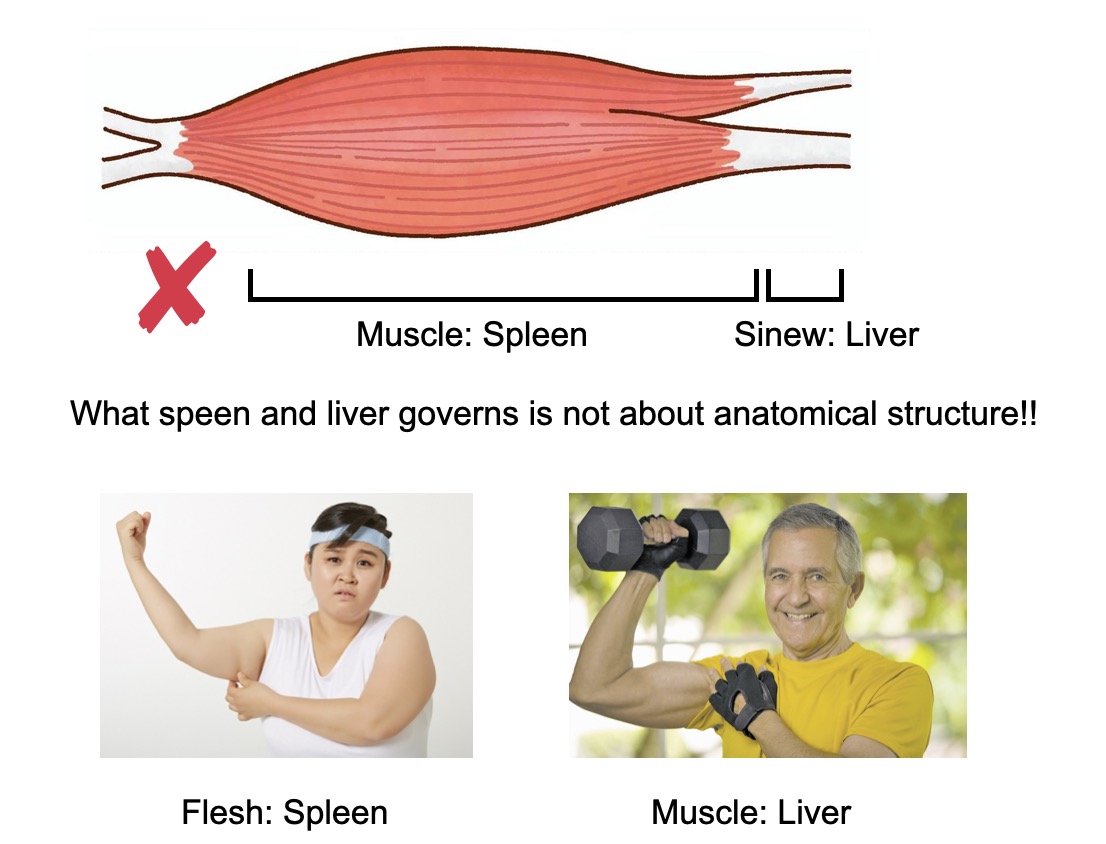
Spleen governs Flesh (肉)
비장(脾)은 살(Flesh, 肉)을 주관한다
Liver governs Muscle (筋)
간(肝)은 근육(Muscle, 筋)을 주관한다
Neijing says "Spleen governs 肉, and Liver Governs 筋. The key to resolving this confusion lies in the original Chinese characters themselves.
이 혼동을 해결하기 위한 열쇠는 바로 원문 한자 그 자체에 있습니다.
The Answer is in the Characters
해답은 한자에 있다
When we move away from a Western anatomical view and look at the functional meaning of the characters, the confusion becomes clear.
서양 해부학적 관점에서 벗어나, 원문 한자의 기능적 의미를 살펴보면 혼란은 명확해집니다.
肉
ròu
Spleen
筋
jīn
Liver
肉 (ròu)
- Collins: 1. (human) flesh 2. (animal) meat
- Google Translate: meat
- Key Point: No dictionary translates it as 'muscle'.
- 콜린스 사전: 1. (사람) flesh(살) 2. (동물) meat(고기)
- 구글 번역: meat(고기)
- 핵심: 어떤 사전도 'muscle'로 번역하지 않습니다.
筋 (jīn)
- Collins: 1. (tendon) tendon 2. (muscle) muscle
- Google Translate: muscle
- Related term (筋骨): Wiktionary & LIFE Science Dictionary define this as "muscles and bones" or "musculoskeletal system".
- 콜린스 사전: 1. (tendon) 건 2. (muscle) 근육
- 구글 번역: muscle(근육)
- 관련 용어 (筋骨): 위키낱말사전 & LIFE 과학사전은 "근육과 뼈" 또는 "근골격계"로 정의합니다.
Dictionaries consistently point to 筋 as muscle and 肉 as flesh/meat.
사전들은 일관되게 筋을 muscle로, 肉을 flesh/meat로 지목합니다.
A Difference in Function, Not Form
형태가 아닌 기능의 차이
肉
Flesh / Inactive Muscle
살 / 비활성 근육
+
力
Action / Force
움직임 / 힘
=
筋
Muscle in Action
움직이는 근육
(Click this card to reveal the explanation)
(카드를 클릭하여 설명을 확인하세요)
In TCM, 肉 (ròu)
and 筋 (jīn) are not materially different. They describe the
*same tissue* in different functional states.
肉 (ròu) refers to the tissue in its passive, structural, and
nourishing state—like flesh or an inactive muscle. It provides form and substance. This is the
domain of the Spleen.
When that same tissue is engaged in movement, contraction, and exertion, it is called 筋 (jīn). This refers to its active, dynamic function. This is the
domain of the Liver.
한의학에서 肉(육)과 筋(근)은 물질적으로 다른 조직이 아닙니다. 다른 기능적 상태에 있는 *같은 조직*을 설명합니다.
肉(육)은 수동적이고 구조적이며 영양을 공급하는 상태의 조직(살, 비활성 근육)을 의미합니다. 형태와 실체를 제공하며, 이는
비장(脾)의 영역입니다.
그 동일한 조직이 움직임, 수축, 힘쓰기에 관여할 때 筋(근)이라고 불립니다. 이는 능동적이고 역동적인 기능을 의미하며,
이는 간(肝)의 영역입니다.
Practical Implications in Diagnosis
진단에서의 실용적 차이
Spleen Governs 肉 (Flesh)
비장이 肉(살)을 주관할 때
Focus: Structure, Metabolism, Nourishment
초점: 구조, 대사, 영양
- Weight gain or muscle atrophy
- Feeling sluggish and heavy
- Poor digestion and metabolism
- Weak limbs, lack of substance
- 체중 증가 또는 근육 위축
- 몸이 무겁고 나른함
- 소화불량 및 대사 저하
- 사지가 무력하고 살이 없음
Liver Governs 筋 (Muscle)
간이 筋(근육)을 주관할 때
Focus: Movement, Flexibility, Tension
초점: 움직임, 유연성, 긴장
- Muscle spasms, cramps, or tremors
- Tight, stiff, or inflexible muscles
- Tendonitis or issues with joint mobility
- Conditions related to Wind, like tetanus
- 근육 경련, 쥐, 떨림
- 뻣뻣하고 경직된 근육
- 건염 또는 관절 가동성 문제
- 파상풍과 같은 풍(風) 관련 질환
Test Your Understanding
이해력 테스트
Check the core distinction: passive substance vs. active function.
수동적 물질 vs 능동적 기능의 핵심 차이를 확인해 보세요.
Quiz 1: You've ordered sirloin at a steakhouse. Is the sirloin on your plate governed by the Spleen or the Liver?
퀴즈 1: 스테이크하우스에서 등심을 주문했습니다. 접시에 놓인 등심은 비장(脾)의 주관일까요, 간(肝)의 주관일까요?
Quiz 2: You repeatedly injure your calf muscle or Achilles tendon at the gym. Is this recurring injury related to the Spleen or the Liver?
퀴즈 2: 헬스장에서 반복적으로 종아리 근육이나 아킬레스건에 부상을 입습니다. 이 반복적인 부상은 비장(脾)과 관련이 있을까요, 간(肝)과 관련이 있을까요?
Quiz 3: You sprained your back while exercising and now can't walk. Should you needle the Liver channel or the Spleen channel?
퀴즈 3: 운동하다 허리를 삐끗해서 현재 걷지를 못합니다. 간 경락에 침을 놓아야 할까요, 비장 경락에 침을 놓아야 할까요?
Quiz 4: You've been gaining weight for no obvious reason. In Korean, people often say they are “gaining 살,” where 살 means “flesh” (肉, ròu). Is this related to the Spleen or the Liver?
퀴즈 4: 최근 들어 이유 없이 살이 찌고 있습니다. '살이 찐다'에서 '살'은 肉(육)을 의미합니다. 이는 비장(脾)의 문제일까요, 간(肝)의 문제일까요?
Critical Analysis: Refuting Maciocia's View
비평: 마시오시아 이론의 결정적 오류
Reference: The Misinterpretation
참고: 지오바니 마시오시아의 견해 (비평 대상)
"Finally, mention should be made of the fact that most Western books on acupuncture list the ‘muscles’ as being controlled by the Liver and ‘flesh’ by the Spleen: I translate jin (the tissue controlled by the Liver) as ‘sinews’ (which includes tendons, ligaments of the limbs and cartilages) and rou or ji rou (the tissue controlled by the Spleen) as ‘muscles’. First of all, it should be noted that ji rou indicating ‘muscles’ refers only to the skeletal muscles in the limbs (and therefore not the cardiac muscle or the smooth muscles). Secondly, obviously there is an overlap in the physiology and pathology of sinews and muscles and therefore between Liver and Spleen. Essentially, a weakness of the limb muscles is related to the Spleen, while cramps, contractions, difficulty in flexion/extension reflect a pathology of the Liver."
"마지막으로, 대부분의 서양 침구 서적들이 '근육(muscles)'은 간이 조절하고 '살(flesh)'은 비장이 조절한다고 기재하고 있다는 점을 언급해야겠습니다. 저는 진(筋, 간이 조절하는 조직)을 '건(sinews, 팔다리의 힘줄, 인대 및 연골 포함)'으로, 육(肉) 또는 기육(肌肉, 비장이 조절하는 조직)을 '근육(muscles)'으로 번역합니다. 우선, '근육'을 나타내는 기육(肌肉)은 사지의 골격근만을 지칭한다는 점에 유의해야 합니다(따라서 심장근이나 평활근은 아닙니다). 둘째로, 건(sinews)과 근육(muscles)의 생리와 병리, 그리고 간과 비장 사이에는 분명히 겹치는 부분이 있습니다. 본질적으로, 사지 근육의 위약(weakness)은 비장과 관련이 있는 반면, 경련, 수축, 굴신(굽히고 펴기)의 어려움은 간의 병리를 반영합니다."
1. Misguided Originality
1. 잘못된 독창성 (Why "Most Western Books" differ)
Maciocia notes that "most Western books" disagree with him. This is because those books were guided by native Chinese or Korean experts who understood the characters 肉 and 筋 in their true cultural context. They correctly identified the fleshy substance as Spleen-governed. Maciocia's deviation is not an advanced insight, but a departure from the source integrity.
마시오시아는 "대부분의 서양 서적"이 자신과 다르다는 점을 스스로 언급합니다. 그 이유는 해당 서적들이 한자 문화권의 원어민 전문가들의 지도를 받았기 때문입니다. 그들은 肉과 筋의 본질을 정확히 이해하고 있었습니다. 마시오시아의 독창적인 해석은 학문적 진보가 아니라, 원문의 본질에서 벗어난 오류입니다.
2. A Theory Built on Sand
2. 모래 위에 쌓은 이론 (Maciocia's Delusion)
Separating 'sinews' and 'muscles' in this manner is a personal re-interpretation that ignores linguistic reality. By redefining terms to fit his own logical framework rather than accepting the standard definition of the Hanja, he created unnecessary confusion. This suggests a superficial understanding of the language, constructing a theory based on imagination rather than etymological fact.
'건'과 '근육'을 억지로 분리한 것은 언어적 현실을 무시한 저자 개인의 자의적 재해석에 불과합니다. 한자의 표준적인 의미를 수용하는 대신 자신의 논리적 틀에 끼워 맞추기 위해 용어를 재정의함으로써 불필요한 혼란을 초래했습니다. 이는 한자에 대한 이해가 부족함을 드러내는 것이며, 문헌학적 사실이 아닌 개인적 상상(혹은 망상) 위에 이론을 구축했다는 비판을 피할 수 없습니다.