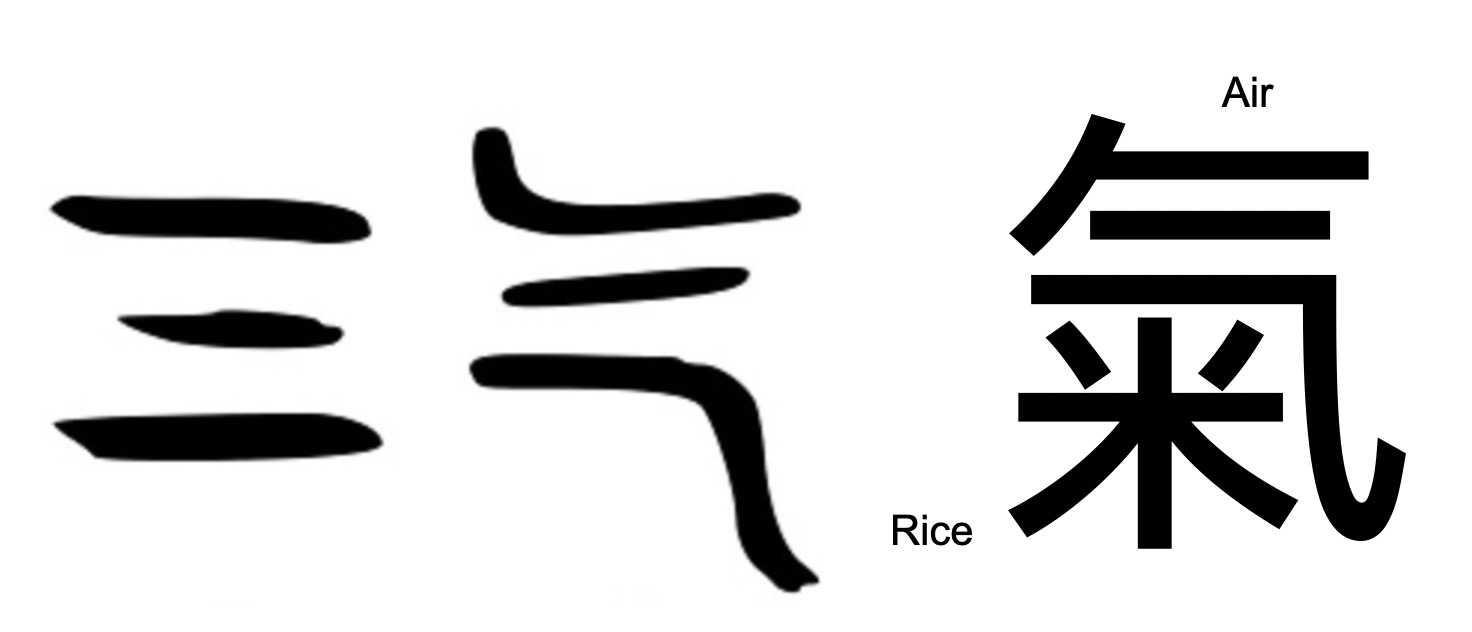
동양 철학에서 가장 중요한 개념 중 하나인 ‘기(氣)’는 그 글자 자체에 깊은 의미가 담겨 있습니다. 이 글자가 어떻게 만들어지고 결합되었는지 살펴보면 고대인들이 ‘기’를 어떻게 이해했는지 명확하게 알 수 있습니다.
기의 가장 원시적인 형태는 갑골문에서 발견되는 ‘气(기)’입니다. 이 글자는 숫자 셋(三)과 유사하게 세 개의 수평선으로 그려졌습니다. 그림에서 왼쪽은 갑골문, 오른쪽은 청동기에 쓰여진 금문입니다. 금문은 거의 현재의 한자 기의 모습과 유사하지요. 이는 눈에 보이지 않는 공기의 흐름, 즉 바람이 불거나 구름, 아지랑이, 수증기 등이 피어오르는 모습을 형상화한 상형문자입니다. 이것이 ‘기’의 본래 의미인 ‘하늘의 기운(天氣)’ 또는 ‘숨결’과 같은 비물질적 에너지를 나타냈습니다. 《설문해자(說文解字)》에서도 “气는 구름의 기운이다(云气也)”라고 정의합니다.
시간이 지나면서 이 ‘气’라는 개념에 ‘米(미)’, 즉 ‘쌀’이라는 글자가 더해져 현재 우리가 아는 ‘氣(기)’라는 글자가 완성되었습니다. 이렇게 기(氣)는 하늘의 기(气)와 땅의 기(米)가 만나서 만들어진 것이죠.
Formation and Circulation of Qi
In Eastern philosophy, one of the most important concepts is “Qi (氣)”, and the very structure of this character carries profound meaning. By examining how this character was created and combined, we can clearly understand how ancient people perceived “Qi.” The most primitive form of Qi appears in Oracle Bone Script as 气. This early form is drawn with three horizontal lines, resembling the number three (三). In the illustration, the character on the left is from the oracle bones, and on the right is from Bronze Script—already close to the modern form. It depicts the invisible flow of air—wind, rising clouds, mist, or vapor. It is a pictograph representing the ethereal energy of the heavens, such as breath or atmospheric vitality.
Over time, this concept of 气 was combined with the character 米 (rice), creating the modern character 氣. This addition depicts the rising steam when rice is cooked in a pot. It vividly illustrates the process in which a material substance (grain), when meeting fire and water, transforms into immaterial energy (vapor). When this food is eaten, it becomes the source of human vitality. This is the perfect metaphor for the essence of Qi—the transformation from matter into energy, the very foundation of life force. In this way, the qi of Heaven(气) and the qi of Earth(米) come together to form Qi(氣).
천기는 주로 폐의 호흡에 의해 공급되고, 지기(곡기)는 비의 운화기능에 의해 가슴으로 전해집니다. 이 천기와 곡기(지기)가 가슴에서 만나 인체를 영양하는 기운이 됩니다. 이른 만난다고 하여 종기라고합니다. 종기는 우리가 살아가면서 자연으로 부터 얻어 생명활동을 이어가기 때문에 후천지기라고도 합니다. 사람에게는 후천지기외에 선천지기도 있습니다. 이를 흔히 원기라고 합니다. 이 원기와 종기를 모두 합하면, 우리 몸을 지탱하는 모든 기운을 뜻하며 이를 진기라고 합니다. 이 진기는 우리 몸을 순행하며 모든 신체활동, 정신활동을 유지합니다. 이 진기는 몸에서 다니는 경로에 따라 체표를 다니며 몸을 보호하는 위기, 경맥을 따라 흐르며 신체를 자양하는 영기로 나뉘기도 합니다.
주: 원래 쌀(米)이 들어간 ‘氣’는 완전히 다른 글자였습니다. 氣, 이 글자의 원래 음은 ‘희(xì)’였으며, 《설문해자》에 따르면 “손님에게 음식을 선물로 보낸다(饋客芻米也)”라는 뜻이었습니다. 즉, 쌀(米)을 포함한 곡식을 다른 이에게 ‘보내는 행위’나 ‘선물하는 음식’을 의미했습니다. 이 두 글자는 소리도 뜻도 완전히 달랐습니다. 气(기)는 ‘기운’, 氣(희)는 ‘음식을 보냄’이었습니다. 쌀이 기운(마음)을 타고 전해지는 모습을 형상화한 글자이지요. 사람들이 ‘음식을 보낸다’는 뜻의 ‘氣(희)’라는 글자에 ‘기운’이라는 철학적 의미를 덧씌우기 시작했습니다. 시간이 흐르면서 ‘음식을 보낸다’는 본래의 뜻은 餼(보낼 희 - 食 부수 추가)라는 별도의 글자가 맡게 되고, ‘氣’는 오로지 ‘기운’이라는 뜻으로만 쓰이게 되었습니다. 혹은 쌀(곡식)을 솥에 넣고 밥을 지을 때 피어오르는 뜨거운 ‘김’을 형상화한 것이 ‘氣'라고도 합니다. 물질(米)이 불과 물을 만나 수증기(气)라는 비물질적 에너지로 변환되고, 섭취되어 생명력으로 전환되는 과정은 ‘기’의 본질을 잘 보여줍니다.
Heavenly Qi is primarily supplied through the lungs via breathing, while Earthly Qi (grain Qi) is transformed and transported to the chest by the spleen’s function. These two—Heavenly Qi and Grain Qi—meet in the chest to form what is called “Gathering Qi” (宗氣, Zong Qi). Because this is the Qi obtained through postnatal interaction with nature, it is also called “Postnatal Qi” (後天之氣). In addition to this, humans are also born with “Original Qi” (元氣)—the innate life force, Prenatal Qi (先天之氣). Together, Gathering Qi and Original Qi form what is known as “True Qi” (眞氣), which circulates throughout the body, sustaining all physiological and mental activities. True Qi is further classified according to its pathways: Defensive Qi (衛氣), which flows on the body’s surface to protect it, and Nutritive Qi (營氣), which flows through the meridians to nourish the body.
Note: Originally, the character 氣 with “rice” (米) had a completely different pronunciation and meaning—it was pronounced xì and, according to Shuowen Jiezi, meant “to send food as a gift to a guest” (饋客芻米也). 气 meant “vital energy,” while 氣 meant “to offer food.” Over time, people overlaid the philosophical idea of “vital energy” onto the latter. The original meaning of “to send food” was eventually taken over by the character 餼, while 氣 came to exclusively mean “Qi”—the life force. It is also said that the character “氣” (qi) was inspired by the image of the hot steam rising when rice is cooked in a pot. When the material substance (rice) meets fire and water, it transforms into vapor (qi) — an immaterial energy — which is then consumed and converted into life force. This process vividly illustrates the essence of qi.
용어 해설
천기 (天氣) — 호흡을 통해 들이마시는 기운
지기·곡기 (地氣·穀氣) — 음식에서 얻는 물질적 기
종기 (宗氣; 後天之氣) — 흉중에서 천기+곡기 결합
원기 (元氣; 先天之氣) — 선천적으로 타고난 기
진기 (眞氣) — 원기+종기의 총합으로 전신을 운행
위기 (衛氣) — 체표를 순행하며 방어
영기 (營氣) — 경맥을 따라 자양
Glossary
Heavenly Qi (天氣) — Vital breath inhaled through the lungs
Earthly / Grain Qi (地氣·穀氣) — Material Qi derived from food
Gathering Qi (宗氣; Postnatal Qi) — Convergence of Heavenly + Grain Qi in the chest
Original Qi (元氣; Prenatal Qi) — Innate prenatal vitality
True Qi (眞氣) — Sum of Original + Gathering Qi circulating body-wide
Defensive Qi (衛氣) — Circulates on the surface, protecting the body
Nutritive Qi (營氣) — Nourishes through the meridians